


View: 


Categories
- Active Record
- Active Resource
- Active Support
- Administration
- Ajax
- APIs
- Authentication
- Authorization
- Background Jobs
- Caching
- Code Walkthrough
- Controllers
- Debugging
- Deployment
- eCommerce
- Forms
- Mailing
- Models
- Performance
- Plugins
- Production
- Rack
- Rails 2.0
- Rails 2.1
- Rails 2.2
- Rails 2.3
- Rails 3.0
- Rails 3.1
- Rails 3.2
- Rails 4.0
- Refactoring
- Routing
- Search
- Security
- Testing
- Tools
- Views
STI and Polymorphic Associations
Single Table Inheritance (STI) can help organize branching logic into separate classes, but a polymorphic association may be a better fit if there are unique database columns.
(14 minutes)

Guest User Record
Instead of presenting a sign up form to the user, consider creating a temporary guest record so the user can try out the application without filling in their information up front. They can then become a permanent member afterwards.
(9 minutes)
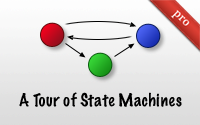
A Tour of State Machines
Here I show how three popular state machine gems can be used to clean up a list of boolean/datetime fields. I also show a custom solution which keeps track of the history of events.
(12 minutes)

Site-Wide Announcements (revised)
Here I show how to add an announcement message at the top of every page in the application and allow the user to permanently hide it. This is all done test-first and even includes testing the JavaScript behavior.
(11 minutes)

Testing JavaScript with PhantomJS
PhantomJS allows us to test JavaScript without going through a browser window. Here I show how to do this using Capybara and Poltergeist. I also give some tips on handling database transactions and skipping javascript tests.
(10 minutes)

Turbolinks
Turbolinks can make your Rails app feel faster by using JavaScript to replace the page content when clicking a link. It will be default in new Rails 4.0 applications, but here I show how to use it in Rails 3 and mention some of the gotchas.
(7 minutes)
Time Zones (revised)
Active Support makes it easy to work with time zones. Learn how to add a Time Zone select field to a user form and watch out for the gotchas.
(7 minutes)
Multitenancy with PostgreSQL
PostgreSQL Schemas can help create a multi-tenant app by keeping data separate at the database layer. Integrating with migrations can be tricky though, so watch this episode for the full details.
(11 minutes)

Multitenancy with Scopes
A multi-tenant application can be difficult to implement because the data for each tenant must be completely separate. Here I show how to do this using subdomains and default scopes in Active Record.
(12 minutes)
Cache Digests
The cache_digests gem (also included in Rails 4) will automatically add a digest to the fragment cache key based on the template. If a template changes the cache will auto-expire. But watch out for the gotchas!
(7 minutes)