


View: 


Categories
- Active Record
- Active Resource
- Active Support
- Administration
- Ajax
- APIs
- Authentication
- Authorization
- Background Jobs
- Caching
- Code Walkthrough
- Controllers
- Debugging
- Deployment
- eCommerce
- Forms
- Mailing
- Models
- Performance
- Plugins
- Production
- Rack
- Rails 2.0
- Rails 2.1
- Rails 2.2
- Rails 2.3
- Rails 3.0
- Rails 3.1
- Rails 3.2
- Rails 4.0
- Refactoring
- Routing
- Search
- Security
- Testing
- Tools
- Views
Applied Filters:
Controllers x

Handling Exceptions (revised)
By default, Rails will render a static error file when an exception occurs in production. Here you will learn how to fully customize this behavior and render dynamic error pages.
(11 minutes)

Service Objects
Models can quickly become a grab-bag of unrelated methods if behavior is constantly being pushed from the controller. Here I show how to refactor this using Concerns and Service Objects.
(12 minutes)

Action Controller Walkthrough
Do you ever wonder what goes on behind the scenes when a Rails controller handles a request? What do the "render" and "redirect_to" methods do exactly? This and more covered as we walk through the code of ActionController::Base.
(11 minutes)
Destroy without JavaScript (revised)
A destroy link in Rails does not work without JavaScript. In this episode I show two techniques for gracefully degrading destroy links: button_to and a delete action.
(8 minutes)

The Rails API Gem
It is often asked: Is Rails a good fit if I only need to serve an API? In this episode I show how to use the Rails API gem to create a slimmer Rails application designed to respond with JSON.
(9 minutes)
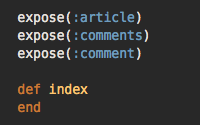
Decent Exposure
The decent_exposure gem makes it convenient to share controller data with the view through methods instead of instance variables.
(9 minutes)
Inherited Resources
Inherited Resource simplifies RESTful controllers by providing default actions which can be customized through inheritance.
(9 minutes)
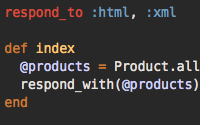
Controllers in Rails 3
Embedded flash notices, permanent cookies, and the details of respond_with are in this episode.
(10 minutes)

Mobile Devices
Change the look and behavior of a Rails app on mobile devices. Also use jQTouch to build a native-looking interface.
(13 minutes)
Self-Referential Association
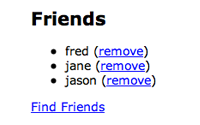
Creating a social networking site often requires a self-referential association on the User model to define friends/followers. In this episode I show how to do exactly that.
(14 minutes)